Weather Alert in New Mexico
Red Flag Warning issued February 17 at 1:26AM MST until February 17 at 7:00PM MST by NWS Albuquerque NM
AREAS AFFECTED: Northeast Plains; Northeast Highlands; East Central Plains
DESCRIPTION: ...RED FLAG WARNING TODAY FROM 10 AM TO 7 PM FOR THE NORTHEAST HIGHLANDS, AND THE EAST CENTRAL AND NORTHEAST PLAINS, DUE TO STRONG WINDS AND LOW HUMIDITY... ...RED FLAG WARNING WEDNESDAY FROM 10 AM TO 7 PM FOR THE NORTHEAST AND CENTRAL HIGHLANDS, AND THE NORTHEAST AND EAST CENTRAL PLAINS, DUE TO STRONG WINDS AND LOW HUMIDITY... ...FIRE WEATHER WATCH WEDNESDAY FROM 10 AM TO 7 PM FOR THE MIDDLE RIO GRANDE VALLEY DUE TO STRONG WINDS AND LOW HUMIDITY... .Strong to damaging southwest and west winds will impact eastern areas today with critical fire weather conditions. Peak wind gusts of 55 to 70 mph with minimum humidities from 14 to 25 percent will enable rapid fire spread in fine fuels. Another day of strong to potentially damaging southwest winds is expected on Wednesday, when humidities will drop between 8 and 22 percent across central and eastern NM. Winds will weaken some while shifting out of the northwest on Thursday, and humidities will climb some, but there is a roughly 25 percent chance that critical fire weather conditions will return to some areas east of the central mountain chain. The National Weather Service in Albuquerque has issued a Red Flag Warning...which is in effect from 10 AM to 7 PM MST Wednesday. The Fire Weather Watch is no longer in effect. * AREA AND TIMING...Northeast Highlands (Zone 123), Northeast Plains (Zone 104), and East Central Plains (Zone 126) today and Wednesday from 10 AM until 7 PM MST. * 20 FOOT WINDS...For today, southwest to west 30 to 40 mph with peak gusts from 55 to 70 mph. For Wednesday, southwest winds 20 to 35 mph with gusts between 45 and 50 mph. * RELATIVE HUMIDITY...For today, minimum values of 14 to 25 percent. For Wednesday, minimum values of 8 to 20 percent. * IMPACTS...Any fires that develop will likely spread rapidly. Outdoor burning is not recommended.
INSTRUCTION: Please advise the appropriate officials or fire crews in the field of this Red Flag Warning.
Want more detail? Get the Complete 7 Day and Night Detailed Forecast!
Current U.S. National Radar--Current
The Current National Weather Radar is shown below with a UTC Time (subtract 5 hours from UTC to get Eastern Time).

National Weather Forecast--Current
The Current National Weather Forecast and National Weather Map are shown below.

National Weather Forecast for Tomorrow
Tomorrow National Weather Forecast and Tomorrow National Weather Map are show below.

North America Water Vapor (Moisture)
This map shows recent moisture content over North America. Bright and colored areas show high moisture (ie, clouds); brown indicates very little moisture present; black indicates no moisture.

Weather Topic: What are Altocumulus Clouds?
Home - Education - Cloud Types - Altocumulus Clouds
 Next Topic: Altostratus Clouds
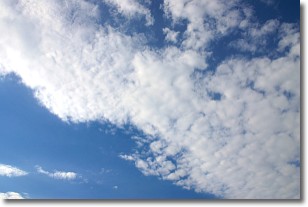
Similar to cirrocumulus clouds, altocumulus clouds are
characterized by cloud patches. They are distinguished by larger cloudlets
than cirrocumulus clouds but are still smaller than stratocumulus clouds.
Altocumulus clouds most commonly form in middle altitudes (between 2 and 5 km)
and may resemble, at times, the shape of a flying saucer.
These uncommon formations, called altocumulus lenticularis, are created by uplift
in the atmosphere and are most often seen in close proximity to mountains.
Next Topic: Altostratus Clouds
Weather Topic: What are Cirrocumulus Clouds?
Home - Education - Cloud Types - Cirrocumulus Clouds
 Next Topic: Cirrostratus Clouds
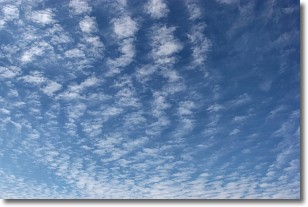
Cirrocumulus clouds form at high altitudes (usually around 5 km)
and have distinguishing characteristics displayed in a fine layer of
small cloud patches. These small cloud patches are sometimes referred to as
"cloudlets" in relation to the whole cloud formation.
Cirrocumulus clouds are formed from ice crystals and water droplets. Often, the
water droplets in the cloud freeze into ice crystals and the cloud becomes a
cirrostratus cloud. Because of this common occurrence, cirrocumulus cloud
formations generally pass rapidly.
Next Topic: Cirrostratus Clouds
Current conditions powered by WeatherAPI.com